Kalshi fee calculator
Enter a price and a number of contracts to see what Kalshi charges, what you need to be right to break even, and whether your own number leaves any edge.
Checked October 20, 2026Select your account’s balance precision: $0.0001 for direct members or $0.01 for non-direct / FCM accounts. This estimates one buy order at the standard rate; special-series multipliers and intermediary charges are excluded. The edge uses the unrounded formula fee, the way the book does. Confirm the fee line on your order screen.
The formula
Kalshi’s taker fee is 0.07 × contracts × P × (1 − P), where P is the price in dollars. The P × (1 − P) part is largest at 50¢ and shrinks toward 1¢ and 99¢, so the fee in dollars peaks in the middle. As a share of what you pay, it is worst on cheap contracts.
| Price | Cost | Taker fee | Fee as share of cost | Break-even |
|---|---|---|---|---|
| 5¢ | $5.00 | $0.3325 | 6.65% | 5.33% |
| 10¢ | $10.00 | $0.6300 | 6.30% | 10.63% |
| 20¢ | $20.00 | $1.1200 | 5.60% | 21.12% |
| 30¢ | $30.00 | $1.4700 | 4.90% | 31.47% |
| 40¢ | $40.00 | $1.6800 | 4.20% | 41.68% |
| 50¢ | $50.00 | $1.7500 | 3.50% | 51.75% |
| 60¢ | $60.00 | $1.6800 | 2.80% | 61.68% |
| 70¢ | $70.00 | $1.4700 | 2.10% | 71.47% |
| 80¢ | $80.00 | $1.1200 | 1.40% | 81.12% |
| 90¢ | $90.00 | $0.6300 | 0.70% | 90.63% |
| 95¢ | $95.00 | $0.3325 | 0.35% | 95.33% |
Break-even is the probability you need for the trade to pay after the fee: the price plus the fee per share. At 62¢ it is 62 + 1.65 = 63.65%. If your honest number is below that, there’s no trade.
Taker or maker
A taker order fills right away against an order already waiting. A maker order names a price and waits for someone else to fill it. Makers pay less or nothing, and research on Kalshi found makers lost far less than takers: about 9.6% of money put in against 31.5%.
What moving money costs
| Method | Deposit | Withdrawal |
|---|---|---|
| Debit card, Apple Pay, Google Pay | Up to 2% ($10 on $500) | Free, to a debit card |
| Bank transfer (ACH) | Free | Free |
| Wire | Free, $1,000 minimum | Not offered under $500,000 |
| PayPal | First deposit free, then up to 2% | Free |
| Crypto | Processor and network fees, shown before you confirm | No Kalshi fee |
Sources: Kalshi help: fees, Kalshi docs: fee rounding, Kalshi help: card deposits.
Questions people ask
How does Kalshi calculate its fees?
Kalshi charges takers 0.07 × number of contracts × price × (1 − price). Kalshi computes it to the hundredth of a cent and rounds up; an account kept in whole cents sees the next cent up, and the difference is credited back across fills.
When are Kalshi fees highest?
In dollars, at 50¢: 100 contracts cost $1.75 in fees. As a share of what you pay, on cheap contracts: at 5¢ the fee is about 6.7% of your cost, against 0.35% at 95¢.
Does Kalshi charge maker fees?
Only on some series. A resting order that someone else fills pays 0.0175 × contracts × price × (1 − price) where the series lists a maker fee, such as Fed decision markets and several sports series. Elsewhere makers pay nothing. Check the fee line on your order screen.
What does it cost to deposit on Kalshi?
Bank transfers (ACH) are free. Debit card, Apple Pay and Google Pay deposits can carry a fee of up to 2%, which is $10 on $500. Wires are free with a $1,000 minimum.
Does Kalshi pay interest on my balance?
Kalshi lists a variable 3.50% APY for eligible US accounts with an average balance of $250 or more. Check its current terms, which can change.
The whole method is in the book
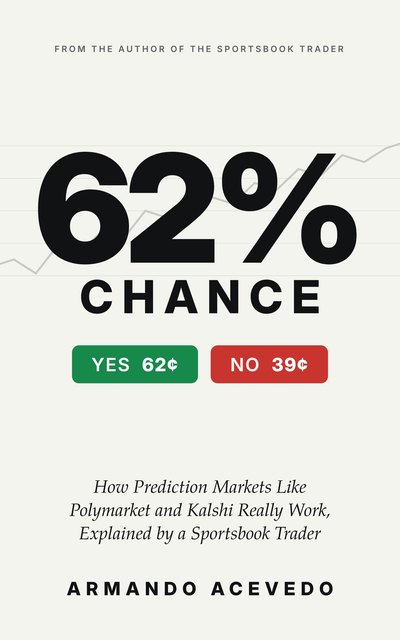
These tools come from 62% Chance, a plain-English guide for beginners by Armando Acevedo, who spent 25 years setting prices for sportsbooks. It follows one new trader from her first look at a price to a tested plan: fees, the order book, borrowing a sportsbook’s sharp prices, bet size, scams, taxes and when to stop.