Trading journal and 30-day challenge
Results lie in the short run. A journal that records your number, the price and the close tells you whether you’re actually good at this.
Trading journal
One row per trade. Write your probability and reason before you look at the price.
Date,Platform,Market,Side,Shares,Price,Fee,Your probability,Reason,Closing price,Result,Profit
(date),Kalshi,Texans beat Colts,Yes,10,0.40,0.17,46%,Receiver back from injury,(price at kickoff),No,-4.17
30-day challenge
Twenty forecasts in at least four categories. The formulas score you and the market.
Market,Category,Your probability,Opening price,Closing price,Result (1 or 0),Your Brier,Market Brier
Chiefs beat Raiders,Sports,0.64,0.60,0.63,1,=(C2-F2)^2,=(D2-F2)^2
Score one forecast
One forecast proves nothing. Score twenty, by category, and compare the averages.
Questions people ask
What is a Brier score?
A grade for forecasts: the average of (forecast − result) squared, where the result is 1 if it happened and 0 if not. Lower is better. Always saying 50% scores 0.25.
What is the closing price and why track it?
The last price before the result starts coming in; for a game, the price at kickoff. It’s the market’s best final estimate. If you regularly buy below the close, you’re making good decisions, whatever the results say in the short run.
The whole method is in the book
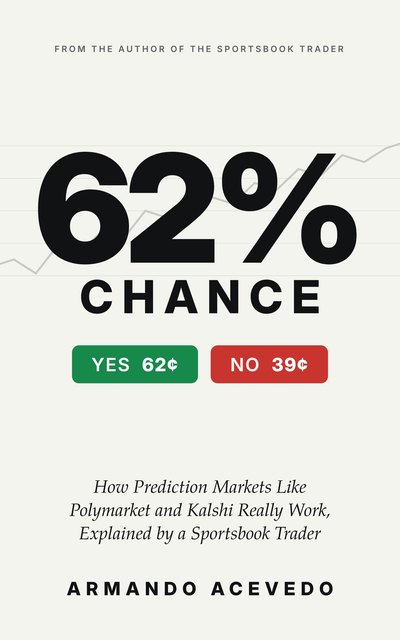
These tools come from 62% Chance, a plain-English guide for beginners by Armando Acevedo, who spent 25 years setting prices for sportsbooks. It follows one new trader from her first look at a price to a tested plan: fees, the order book, borrowing a sportsbook’s sharp prices, bet size, scams, taxes and when to stop.